


 русский
 Español
 Français
Home / News / Industry News / Why is Your Adhesive Failing? How Adhesion Promoter Fixes Low Surface Energy Bonding Issues
Industry News

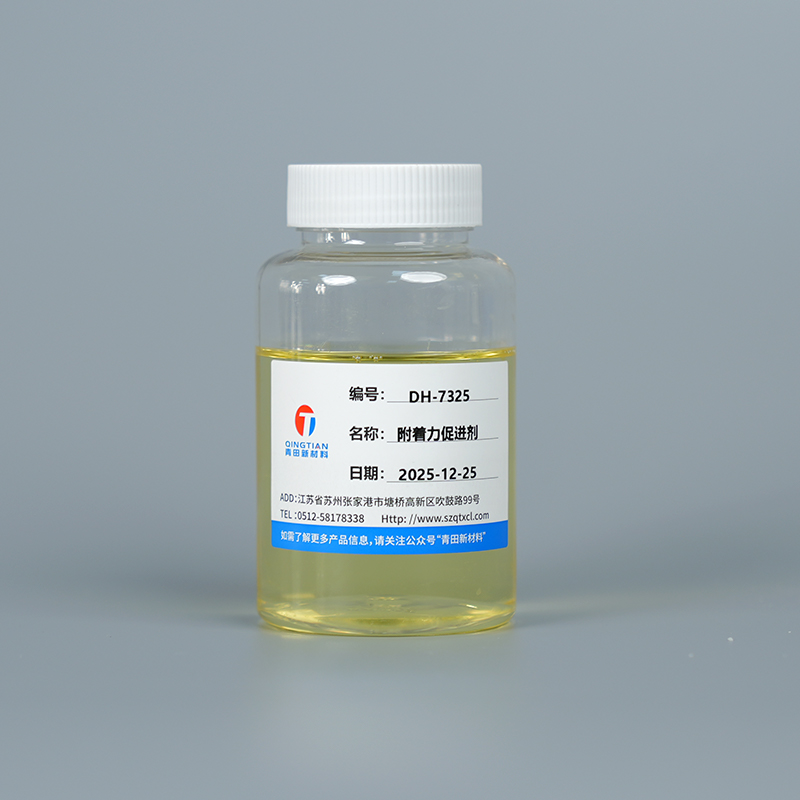
In modern industrial manufacturing and surface treatment processes, secure bonding between different materials is a core element for ensuring product structural integrity and long-term stability. Because many high-performance materials, such as polyolefin plastics, engineering plastics, metals, and composite materials, possess characteristics like low surface energy, high crystallinity, or passivation layers, conventional adhesives often struggle to form sufficient wetting and intermolecular forces on their surfaces. This technical bottleneck directly leads to issues such as peeling, cracking, or poor weather resistance at the bonding interface. To break through this limitation, Adhesion Promoter, as a critical interface modification technology, plays an irreplaceable role in improving interface adhesion.
The primary function of an Adhesion Promoter is to establish a "molecular bridge" across an extremely thin interface layer. Its molecular structure typically features dual functional characteristics: one end can form strong chemical bonds, physical entanglements, or hydrogen bonding with the substrate surface, while the other end carries reactive groups capable of cross-linking with subsequent coatings, inks, or adhesives.
When the Adhesion Promoter is applied to a substrate surface, it rapidly alters the physicochemical properties of that surface. First, it significantly reduces the surface tension of the substrate, allowing the adhesive to fully wet and spread, which expands the actual contact area. Second, it penetrates into the microscopic pores of the substrate, creating a mechanical anchoring effect. Most importantly, it transforms what would be purely physical stacking into high-strength chemical bonding through intermolecular cross-linking, thereby multiplying the interfacial shear and peel strength.
Depending on the substrate material and application environment, the chemical composition used for modification varies. The following table provides a comparison of key technical parameters and performance characteristics for several mainstream types of Adhesion Promoter:
| PP, EPDM, TPO and other polyolefins | Glass, ceramics, metals, oxides | Glass, metals, inorganic mineral fillers | PVC, ABS, PC and other engineering plastics |
| 5 - 15 micrometers | Molecular level monolayer (less than 1 micrometer) | Molecular level monolayer (less than 1 micrometer) | 2 - 10 micrometers |
| -30°C to 90°C | -60°C to 250°C | -50°C to 200°C | -40°C to 120°C |
| Baking (80°C) or ambient evaporation | Ambient hydrolysis or heat cross-linking | Ambient reaction or melt modification | UV curing or solvent evaporation |
| Moderate, relies on film barrier | Excellent, forms stable Si-O-Si bonds | Excellent, features hydrolysis resistance | Good, depends on formulation cross-linking density |
In actual production, surface adhesion failure usually stems from mismatched surface energy or environmental attack. By introducing a targeted Adhesion Promoter, the following frequently encountered industrial problems can be fundamentally resolved:
Bonding and Coating Difficulties on Low Surface Energy Plastics: For materials like PP (polypropylene), the surface energy is typically below 30 mN/m, making direct spraying or bonding highly susceptible to complete peeling. After treatment with a chlorinated polyolefin Adhesion Promoter, the modified layer can securely embed into the PP molecular chains, raising the surface energy to above 40 mN/m and ensuring the subsequent coating adhesion reaches grade 0 (cross-cut tape test).
Moist-Heat Aging and Peeling on Metal Surfaces: Metal materials in humid, high-temperature, or salt spray environments are prone to electrochemical corrosion or hydrolysis at the bonding interface, leading to localized blistering and peeling of the adhesive layer. Silane-based Adhesion Promoter can form covalent bonds (M-O-Si) on the metal surface. These chemical bonds possess exceptional resistance to hydrolysis, maintaining over 85% of the initial bonding strength even after prolonged exposure to moist-heat aging.
Stress Concentration in Dissimilar Material Composites: When rigid metals are laminated and combined with highly elastic rubber or plastics, massive internal shear stress is generated during temperature fluctuations due to differences in linear expansion coefficients. A highly efficient Adhesion Promoter provides a certain viscoelastic buffering effect. While enhancing bonding forces, it can absorb and release interface stresses, preventing fatigue cracking.
To ensure the Adhesion Promoter achieves its optimal modification effect, a standardized application process is essential. First, thorough cleaning of the substrate surface is the foundation; oil grease, mold release agents, rust preventive oils, and dust must be completely removed. Second, controlling the uniformity and thickness of the coating is critical, as an excessively thick layer can form a structurally weak cohesive layer, resulting in a decline in overall adhesion. Finally, strictly adhering to the specified drying or curing time ensures that solvents evaporate completely or chemical reactions finish thoroughly, establishing a dense interfacial network structure to achieve high-strength, long-lasting composite bonding quality.
 Wholesale Paint/ Coating Additives Manufacturers
Custom Industrial Chemical Solutions Suppliers
Wholesale Paint/ Coating Additives Manufacturers
Custom Industrial Chemical Solutions Suppliers